From Forged Carbon Fiber Bars to Finished Jewelry: Why Vertical Manufacturing Matters for Jewelry Brands
For jewelry brands, choosing a new material is not only about appearance. It is also about production stability, repeatability, machining accuracy, surface quality, and whether the material can be developed into a real commercial collection. This is why working with a vertical forged carbon fiber jewelry manufacturer can make a meaningful difference.
As a vertical forged carbon fiber jewelry manufacturer, Ringentle helps jewelry brands connect material development, color control, metal integration, sampling, and finished OEM/ODM production in one process.
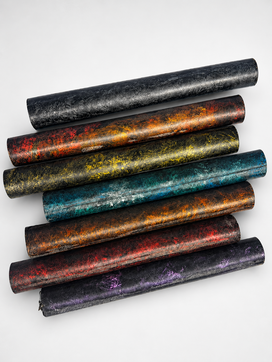
Forged carbon fiber is a strong example of this challenge. At first glance, it may look like a visual material: dark, textured, lightweight, and modern. But for rings, pendants, bracelets, cufflinks, and custom jewelry components, forged carbon fiber must be controlled from the material stage to the finished product stage.
At Ringentle, our work is not limited to finished jewelry assembly. We develop forged carbon fiber materials, colored carbon fiber effects, ring bars, plates, blocks, and finished jewelry components for brand customers. This allows us to support jewelry brands from early material exploration to sample development and scalable production.
Vertical manufacturing connects material development, color control, CNC machining, metal integration, finishing, sampling, and repeat production. For jewelry brands, this means fewer development risks and a clearer path from concept to market-ready product.
Forged Carbon Fiber Is More Than a Decorative Surface
Many jewelry brands first notice forged carbon fiber because of its unique visual texture. Unlike woven carbon fiber, forged carbon fiber has a more random, marble-like pattern. Each piece has a different visual structure, giving the material a natural sense of movement and depth.
For men’s jewelry and alternative metal collections, this creates a strong design language. It feels modern, technical, lightweight, and different from traditional metals. However, for professional jewelry production, visual appearance is only the first step.
A brand also needs to know whether the pattern can be controlled within an acceptable production range, whether the material can be machined into rings or small components, whether color effects can remain stable across batches, and whether the carbon fiber can be combined with titanium, tungsten, tantalum, stainless steel, silver, gold, Damascus steel, or other metals.
These questions are difficult to answer if the material supplier and the jewelry manufacturer are completely separate. A vertical partner can evaluate the material and the final product structure together from the beginning.
Why Material Control Matters Before Jewelry Production
Forged carbon fiber jewelry usually starts from material forms such as rods, bars, plates, or blocks. These material forms determine what can be produced later. For example, forged carbon fiber bars are often used for ring production, while plates and blocks can be used for pendants, cufflinks, bracelet components, custom accessories, or decorative inlays.
If the material is not suitable for machining, the finished jewelry may have problems such as unstable edges, weak structure, inconsistent texture, or limited design flexibility. This is why material development and jewelry production should be considered together from the beginning.
When a factory understands both forged carbon fiber material behavior and finished jewelry requirements, it can suggest a more practical development direction. Material thickness, bar size, color effect, machining allowance, and metal combination method can all be planned more efficiently.
Working with a professional forged carbon fiber jewelry manufacturer that understands both raw material behavior and finished jewelry requirements can help brands reduce sampling uncertainty and improve repeat production stability.
For more material-focused information, our related material platform Carbonaurum introduces forged carbon fiber sheets, bars, plates, and custom material forms for broader applications.
Colored Forged Carbon Fiber Adds a New Development Direction
Traditional forged carbon fiber jewelry is usually black or dark grey. This look is still important because it is classic, technical, and easy to combine with metal. But for many jewelry brands, black carbon fiber alone may not be enough to build a distinctive collection.
Colored forged carbon fiber creates a wider design space. It can be developed in black-gold, deep green, red, rust red, silver grey, purple, blue, iridescent, and other custom visual effects. These colors help brands create stronger product stories and more recognizable collections.
- Black-gold forged carbon fiber can feel luxurious and architectural.
- Deep green forged carbon fiber can feel more organic and distinctive.
- Rust red or red forged carbon fiber can create a bold contrast with black titanium or Damascus steel.
- Silver grey forged carbon fiber can work well with titanium, tungsten, or white gold designs.
For jewelry brands, this means forged carbon fiber is no longer only a black technical material. It can become a design system. You can view more color directions on our Color Lookbook page.
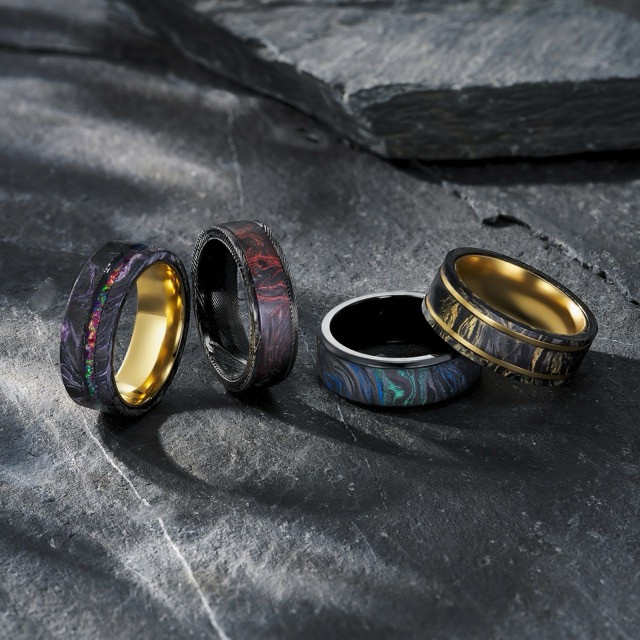
From Carbon Fiber Bars to Finished Rings
Rings are one of the most important applications for forged carbon fiber jewelry. A ring may look simple from the outside, but production involves several important decisions.
Should the carbon fiber be used as a full outer body, an inlay, or a sleeve? Should the inner structure use titanium, tantalum, tungsten, stainless steel, gold, silver, or Damascus steel? Should the carbon fiber color be natural, metallic, chromatic, or custom-developed? What ring width and thickness are suitable for comfort and durability? Can the design be repeated across multiple sizes?
When the same team controls the forged carbon fiber material and the finished ring production, these questions can be solved more directly. This is especially important for brand customers who want to develop a complete ring line rather than a single sample.
Ringentle supports forged carbon fiber rings, ring bars, and carbon fiber + metal integration for OEM/ODM jewelry development.
Metal Integration Is a Key Part of Forged Carbon Fiber Jewelry
Forged carbon fiber becomes much more powerful when it is combined with metal. Different metals create different product positioning, and each metal also creates different technical requirements during machining, assembly, finishing, and quality control.
- Titanium gives a lightweight and technical feel.
- Tungsten creates a strong and durable alternative metal direction.
- Tantalum gives a premium rare-metal identity.
- Gold adds luxury value.
- Stainless steel supports practical production and PVD color options.
- Damascus steel creates strong pattern contrast.
For brand customers, the challenge is not only choosing a metal. The real challenge is how to combine forged carbon fiber and metal cleanly, reliably, and beautifully. This includes mechanical structure, bonding method, machining tolerance, surface finishing, color matching, and long-term production repeatability.
A supplier that only provides carbon fiber material may not fully understand the finished jewelry structure. A jewelry factory that only buys carbon fiber from outside may not fully control the material quality. A vertical forged carbon fiber jewelry manufacturer can connect both sides.
Why Vertical Manufacturing Helps Brand Customers
For jewelry brands, vertical manufacturing can reduce many development risks. Instead of coordinating between a material supplier, a CNC supplier, a plating supplier, and a jewelry assembly factory, the brand can work with one development partner.
Sampling also becomes more efficient. If a color effect, bar size, or machining structure needs adjustment, the factory can make changes from the material stage instead of only modifying the finished sample. Bulk production becomes more stable because the material, machining process, metal structure, and finishing method can be confirmed together.
Vertical manufacturing also helps brands develop a more complete collection. The same forged carbon fiber color system can be used across rings, pendants, bracelets, cufflinks, necklace components, watch components, and other accessories.
Applications Beyond Rings
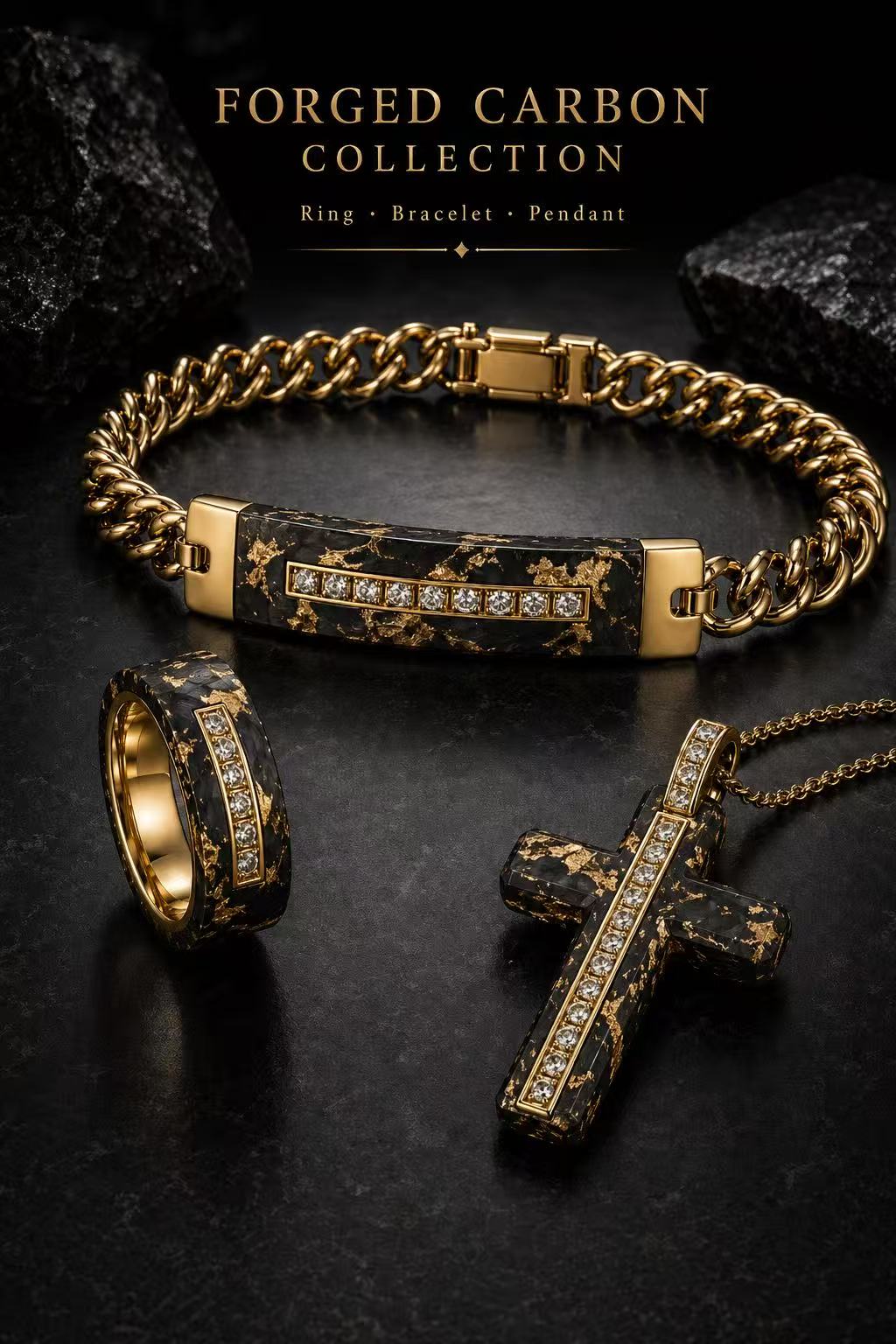
Although rings are a major category, forged carbon fiber can also be used in many other jewelry and accessory products. Because forged carbon fiber can be made into different material forms, it gives designers more freedom. The same material language can be adapted for different product categories.
- Pendants and dog tags
- Bracelet components
- Necklace elements
- Cufflink parts
- Custom metal + carbon fiber components
- Luxury accessories and decorative parts
You can view more Ringentle product categories on our Forged Carbon Fiber Jewelry Product Lines page.
A Better Development Path for Jewelry Brands
For a brand exploring forged carbon fiber, the development process should not begin with a random sample. A better path is to define the product category, choose the material direction, confirm the metal combination, create focused samples, evaluate the result, and then prepare the design for scalable production.
- Define the product category: ring, pendant, bracelet, cufflink, or custom component.
- Choose the material direction: black forged carbon fiber, colored forged carbon fiber, metallic effect, or custom color development.
- Confirm the metal combination: titanium, tungsten, tantalum, stainless steel, gold, silver, Damascus steel, or other materials.
- Create focused samples instead of developing too many directions at once.
- Evaluate appearance, structure, comfort, finishing, production cost, and repeatability.
- Prepare the final design for scalable OEM/ODM production.
This process helps both the brand and the manufacturer avoid unnecessary sample waste and move toward a more realistic commercial product.
Conclusion: Forged Carbon Fiber Should Be Developed as a System
For jewelry brands, forged carbon fiber is not only a visual material. It is a complete development system that includes material form, color effect, machining process, metal integration, surface finishing, and final product production.
This is why working with a vertical forged carbon fiber jewelry manufacturer can make a real difference. At Ringentle, we help jewelry brands develop colored forged carbon fiber rings, pendants, components, and custom OEM/ODM collections from the material stage to finished production.
Whether you need forged carbon fiber bars for ring production, colored carbon fiber materials for design development, or finished jewelry components for your brand collection, we can support the process from concept to production.
For brands seeking a reliable forged carbon fiber jewelry manufacturer, Ringentle provides support from forged carbon fiber bars and colored material effects to the full line of jewelry types.
Develop a Forged Carbon Fiber Jewelry Collection with Ringentle
If your brand is exploring forged carbon fiber rings, pendants, bracelets, necklaces, cufflinks, or custom jewelry components, Ringentle can support material development, color systems, metal integration, sampling, and scalable OEM/ODM production.
FAQ: Forged Carbon Fiber Jewelry Manufacturing
Why does vertical manufacturing matter for forged carbon fiber jewelry?
Vertical manufacturing helps connect forged carbon fiber material development with finished jewelry production. This improves communication, sampling efficiency, machining planning, color consistency, metal integration, and repeat production stability.
What material forms are used before making forged carbon fiber jewelry?
Forged carbon fiber jewelry often starts from rods, bars, plates, blocks, or custom material forms. Bars are commonly used for ring production, while plates and blocks can be used for pendants, cufflinks, bracelet components, inlays, and custom parts.
Can colored forged carbon fiber be used for commercial jewelry collections?
Yes. Colored forged carbon fiber can be developed into production-ready effects such as black-gold, red, rust red, deep green, silver grey, purple, blue, iridescent, and custom visual directions. The key is to control the material and color effect from the development stage.
What metals can be combined with forged carbon fiber?
Forged carbon fiber can be combined with titanium, tungsten, tantalum, stainless steel, Damascus steel, silver, gold, cobalt, and other jewelry metals depending on the product structure and brand positioning.
Does Ringentle support OEM/ODM forged carbon fiber jewelry production?
Yes. Ringentle supports jewelry brands with forged carbon fiber material development, color selection, ring bars, metal integration, sample making, and scalable OEM/ODM production for rings, pendants, bracelets, necklaces, cufflinks, and custom components.