Forged Carbon Fiber Material
Forged Carbon Fiber for Jewelry Production
Ringentle develops forged carbon fiber materials for jewelry brands that need distinctive texture, controlled pattern range, stable production, and reliable integration with modern metal designs.
The Material
What Is Forged Carbon Fiber?
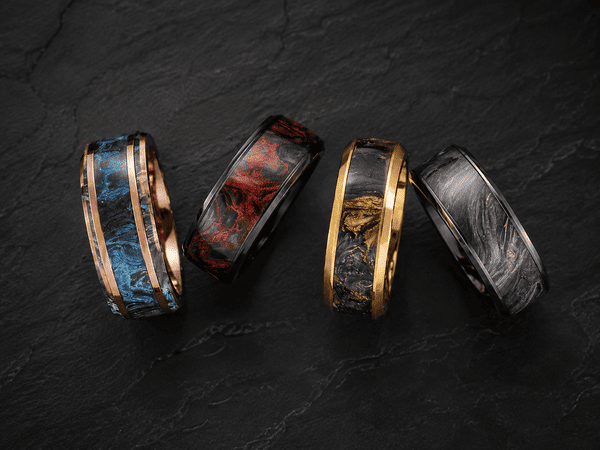
Forged carbon fiber is a composite material made from fine carbon fiber strands arranged in a random direction and compressed into a dense structure. Unlike woven carbon fiber, it does not show a regular fabric grid. Its surface has a natural, marble-like movement created by random fiber distribution.
For jewelry, this gives the material a stronger visual identity. It feels technical, modern, organic, and premium — especially when combined with titanium, stainless steel, gold, Damascus steel, tantalum, tungsten, silver, or other jewelry metals.
Forged vs Woven Carbon Fiber
Not a Regular Weave — A More Organic Jewelry Surface
Woven carbon fiber usually shows a repeated grid or twill pattern. Forged carbon fiber is different. Its chopped fiber structure creates irregular texture, layered depth, and natural variation across the surface.
This is why forged carbon fiber works especially well for rings, pendants, dog tags, bracelets, necklaces, cufflink components, and custom jewelry parts where material identity matters.
Why Jewelry Brands Use It
Lightweight, Technical, and Visually Distinctive
Forged carbon fiber gives jewelry brands a material language that is different from ordinary metals, black coatings, or simple decorative inlays.
Lightweight Feel
Forged carbon fiber is suitable for rings, pendants, bracelets, necklaces, and larger statement components where comfort and visual volume both matter.
Strong Material Identity
The random carbon fiber movement creates a premium technical appearance that helps brands build a more recognizable product language.
Jewelry-Grade Surface
After machining, shaping, polishing, and finishing, forged carbon fiber can achieve a refined tactile surface suitable for jewelry applications.
Flexible Product Forms
It can be developed as rings, inlays, sleeves, bars, blocks, plates, decorative panels, and custom-shaped components for different jewelry structures.
Ringentle Process Control
Controlling Randomness for Brand-Level Production
Forged carbon fiber is naturally random, but jewelry brands still need collection consistency. Ringentle focuses on controlling the acceptable pattern range while preserving the authentic, natural character of the material.
Pattern Range Control
We control fiber distribution, contrast, and texture density so a collection looks consistent without becoming artificial or repetitive.
Machining Stability
Jewelry materials must survive cutting, shaping, bonding, polishing, and finishing. We develop forged carbon fiber with real jewelry manufacturing requirements in mind.
Metal Integration
We combine forged carbon fiber with stainless steel, titanium, gold, tantalum, cobalt, Damascus steel, tungsten, silver, zirconium, and other jewelry materials.
Repeatable Production
A beautiful sample is only the first step. Our goal is to help brands move toward stable, scalable production with controlled pattern and finishing standards.
Colored Forged Carbon Fiber
From Classic Black to Custom Color Effects
Ringentle is not limited to standard black forged carbon fiber. We have developed more than 50 color effects for jewelry production, including black-gold, metallic tones, deep greens, purple effects, aurora-style colors, glow effects, and custom brand directions.
If your project requires a specific visual direction, our Color System page explains how we organize color effects for production, while the Color Lookbook shows available visual references.
Material Specifications
Production-Oriented Material Data
Exact values may vary by resin system, fiber formulation, structure, color effect, and finishing requirements. Final parameters can be confirmed during sample development.
Applications
Forged Carbon Fiber Applications in Jewelry
Ringentle develops forged carbon fiber materials around real product categories, not only raw material display samples.
Rings
Forged carbon fiber rings can be developed with titanium, stainless steel, tungsten, Damascus steel, gold, tantalum, and other metal structures.
Explore RingsPendants & Dog Tags
Lightweight carbon fiber surfaces work well for statement pendants, dog tags, plaques, and decorative inserts.
Explore PendantsBracelets & Necklaces
Forged carbon fiber can be used for links, plates, chain elements, beads, and multi-material jewelry components.
Explore BraceletsCustom Components
For brand projects, forged carbon fiber can be developed into special parts for jewelry, accessories, cufflinks, watch-related components, and custom designs.
Explore ComponentsFAQ
Questions About Forged Carbon Fiber Jewelry Material
Is forged carbon fiber the same as woven carbon fiber?
No. Woven carbon fiber uses regular fabric-like sheets, while forged carbon fiber uses randomly arranged fiber strands to create a more organic, marble-like texture.
Can every pattern be exactly identical?
No. Forged carbon fiber naturally has variation. However, the overall pattern density, contrast, and visual range can be controlled for production consistency.
Can forged carbon fiber be combined with precious metals?
Yes. Depending on the design structure, forged carbon fiber can be combined with gold, silver, titanium, stainless steel, tantalum, tungsten, Damascus steel, and other jewelry materials.
Do you sell only raw forged carbon fiber sheets?
Ringentle focuses on finished jewelry and OEM/ODM production. For raw forged carbon fiber plates, bars, sheets, and broader material applications, you can visit our related material website, Carbon Aurum.
Material Sample Request
Want to Evaluate Forged Carbon Fiber for Your Jewelry Collection?
Share your target product category, color direction, metal combination, and expected quantity. We can recommend suitable forged carbon fiber material effects and sample development options.